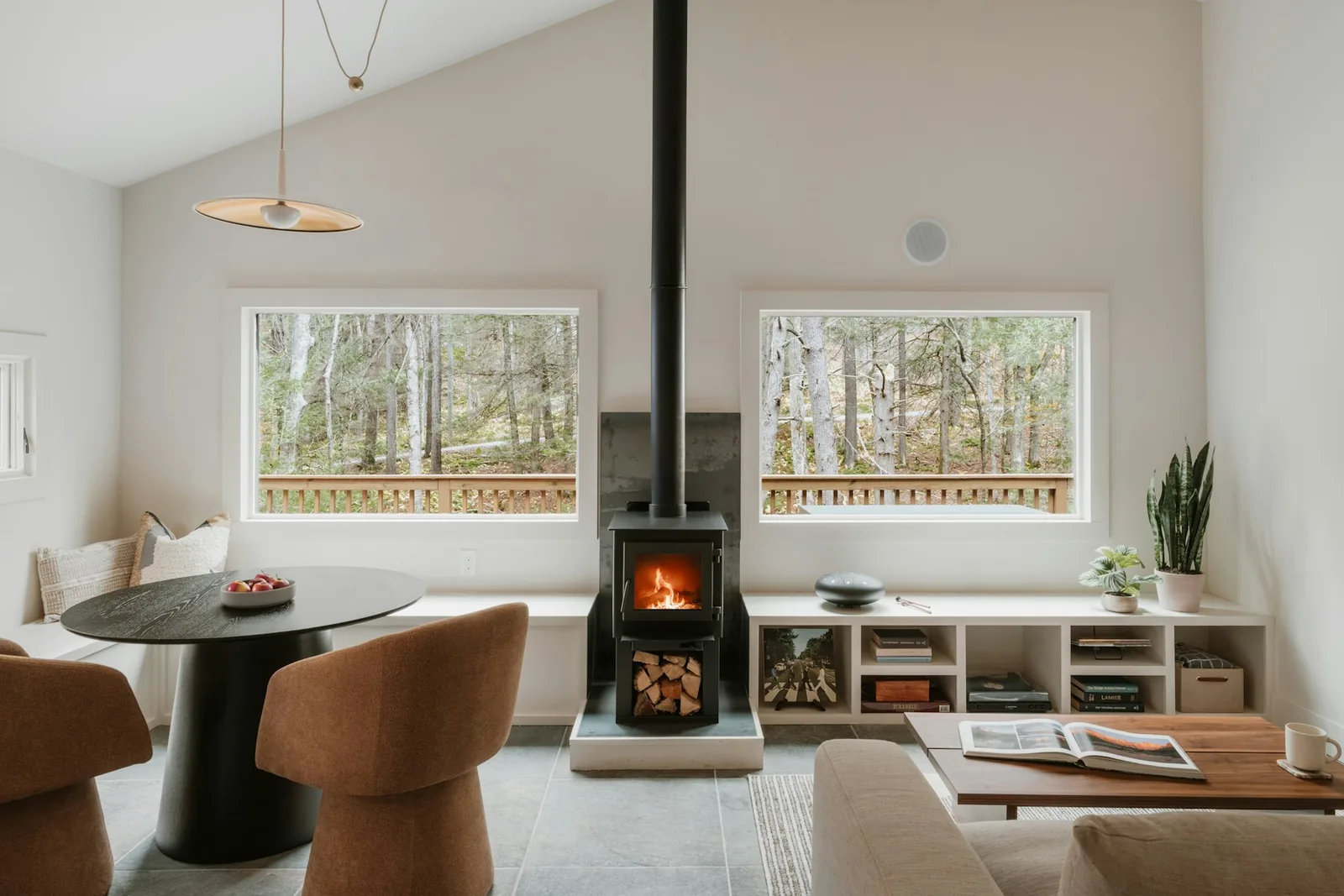
Is my wood stove EPA-certified? How to tell
Look for the EPA label, usually a metal plate on the back or side of the stove. No label usually means uncertified. Solid metal doors or two glass doors point to an older uncertified stove, and a UL listing is not EPA certification. PSCAA also reviews photos sent to woodstove@pscleanair.org.
Seattle Fireplace & Chimney · October 13, 2026
Where to find the label
The Puget Sound Clean Air Agency (PSCAA) says to look for the EPA label on the back or side of the stove. On a freestanding stove it is usually a metal plate riveted to the back panel or the heat shield, and you may need a flashlight and a mirror. It names the maker and model and states the EPA certification.
On a fireplace insert, the label is often harder to reach. It may be behind the surround panel, under the ash lip, or on the side of the firebox where it slides into the fireplace. Do not pull an insert out to look. If you cannot find it, photos and the model name are usually enough to tell.
Clues when there is no label
PSCAA's Tacoma-Pierce FAQ lists the tell-tale signs of an older uncertified stove. None of them prove it alone, but together they are a strong hint.
- No EPA label anywhere on the stove.
- Solid metal doors with no glass.
- Two glass doors side by side, common on older stoves.
- A UL Tested or UL Approved label but no EPA label. PSCAA notes UL is not the same as EPA certification.
Why it matters in the Puget Sound area
Certification decides when and where you may burn. In a Stage 1 burn ban, PSCAA allows EPA-certified stoves and inserts to run if they make no visible smoke, while uncertified stoves must stay cold. In Stage 2, all wood stoves stop, certified or not. Inside the Tacoma-Pierce County Smoke Reduction Zone, using an uncertified stove or insert has been illegal since October 1, 2015; check your address on the map at pscleanair.gov/547.
It also matters when you sell, move or replace a stove. The Department of Ecology says you cannot sell, exchange or give away an uncertified stove, and a homeowner cannot apply to certify one. RCW 70A.15.3520 bars installing a used stove unless it meets Oregon DEQ Phase II or EPA certification. And Washington's seller disclosure, Form 17, asks whether any woodstove or insert is EPA-certified. Ecology confirms you do not have to remove an uncertified stove to sell the house.
Certified is not the same as current
EPA standards have tightened over the years. Ecology says new wood and pellet stoves sold in Washington now have to meet the EPA's 2020 limits: 2.0 grams of smoke per hour tested with crib wood, or 2.5 grams per hour with cord wood. A stove certified in the 1990s met the rules of its day but would not meet those numbers.
That older certified stove is still legal to use outside burn bans, and in a Stage 1 ban if it makes no visible smoke. It is also eligible for PSCAA's $500 recycling payment (pscleanair.gov/409), which covers uncertified stoves and inserts and certified ones that do not meet the 2020 standard. Stoves already certified to the 2020 standard, pellet stoves, gas units and brick fireplaces do not qualify.
What about fireplaces and pellet stoves
A masonry fireplace is not a certified or uncertified device in this sense. RCW 70A.15.3530 exempts masonry fireplaces from the sales rule, and Ecology sets a separate limit of 7.5 grams per hour for factory-built fireplaces. For burn bans, though, PSCAA treats every open wood fireplace the same: off in Stage 1 and Stage 2.
Pellet stoves sold in Washington must be EPA-certified or exempt under RCW 70A.15.3520. Plan on them being off in a Stage 2 ban.
What to do once you know
If the stove is certified and in good shape, keep it, have the chimney and connector checked, and burn only seasoned wood; Washington law bans burning garbage, treated wood, plastics and paint in a stove (RCW 70A.15.3600). If it is uncertified, or certified long ago and smoky, it may be worth replacing. Typical 2026 ranges: an EPA-certified wood stove installed $3,000 to $8,000, a wood insert with a stainless liner $3,000 to $7,000, and a gas insert $2,000 to $8,000.
Our inspection is free. We find the label, look at the stove and chimney top to bottom, take photos and give you a written price for any work, which is also what you need to answer Form 17 accurately.
FAQ
More answers
Can I get my old stove certified?
No. The Department of Ecology says a homeowner cannot apply to certify a wood stove. Certification is done by the manufacturer for a model, before it is sold.
My stove is certified. Can I use it during a burn ban?
In a Stage 1 ban, yes, if it makes no visible smoke, according to PSCAA. In a Stage 2 ban, no wood stove may be used, certified or not.
Is a UL label the same as EPA certification?
No. PSCAA points out that a UL Tested or Approved label is not the same as EPA certification, which comes with its own EPA label.
Will PSCAA tell me if my stove is certified?
Yes. PSCAA says photos of the stove can be emailed to woodstove@pscleanair.org for a look.
Keep reading
More from the blog
 Can I use my fireplace during a burn ban in Seattle?What Stage 1 and Stage 2 burn bans mean for wood fireplaces, certified stoves, pellet stoves and gas fireplaces in King, Pierce, Snohomish and Kitsap.
 Do I have to remove an old wood stove before selling my Washington home?Washington does not require removing an uncertified wood stove before a home sale. What Form 17 asks, the Tacoma zone exception, and your options.
 Tacoma's old wood stove rule and the $500 recycling paymentSince 2015, uncertified wood stoves are illegal to use in the Tacoma-Pierce Smoke Reduction Zone. How to check the zone and claim PSCAA's $500 payment.
Book online
Pick a day. We'll bring a ladder.
Free inspection in a 3-hour window: 8 to 11, 11 to 2, or 2 to 5. We call to confirm before we arrive.